
Despite being the world’s second-largest music market by revenue, Japan remains an outlier in the global streaming landscape. A recent study by Skoove and DataPulse Research found that a staggering 81% of the tracks on Japan’s Spotify Top 200 are by Japanese artists — one of the highest local-dominance rates in the world, even higher than the US.
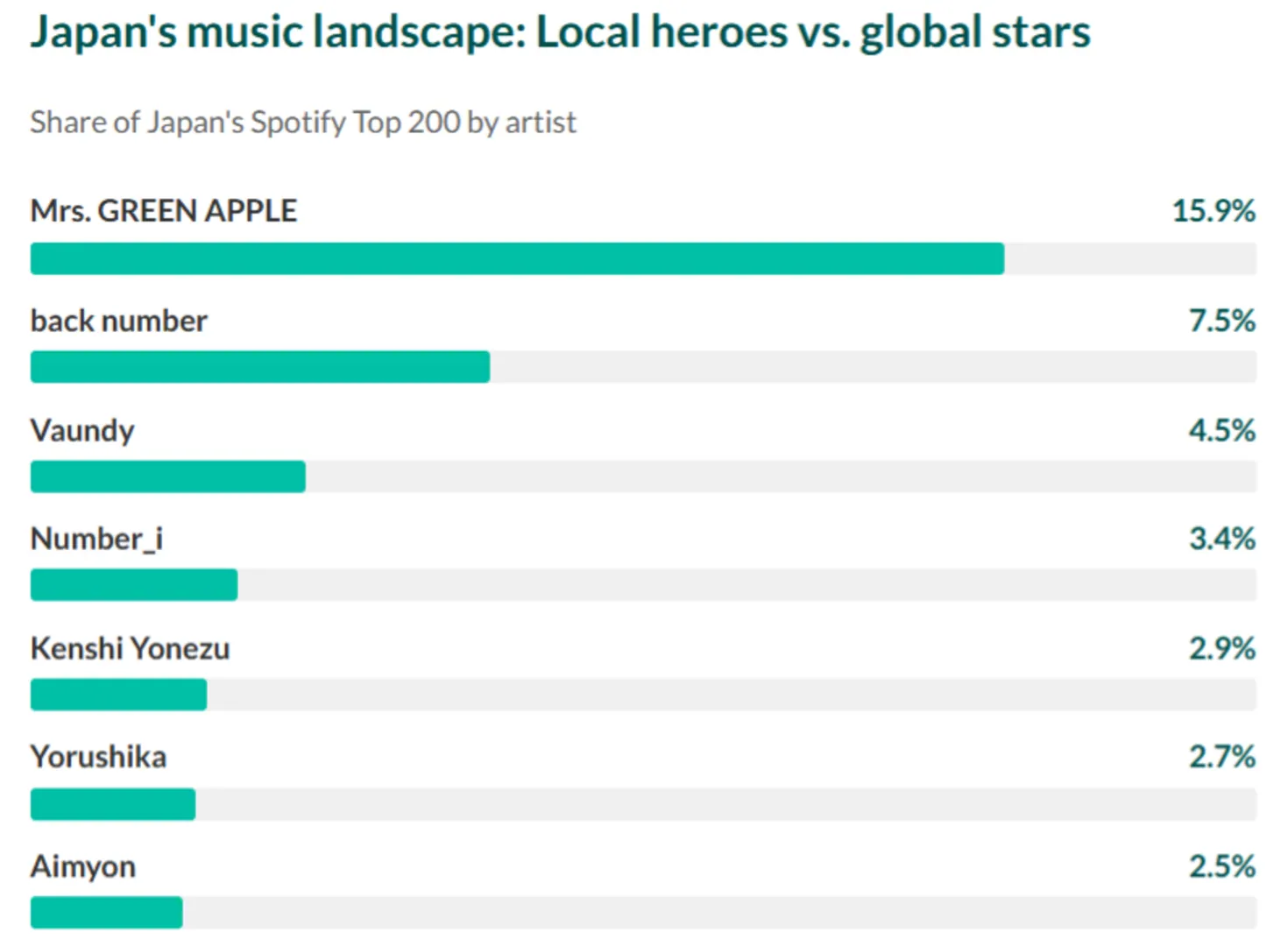
While international superstars dominate Spotify charts elsewhere, Japan marches to its own beat. Japanese acts like Mrs. GREEN APPLE, back number, Vaundy, Kenshi Yonezu, and YOASOBI consistently top the local charts. In fact, Mrs. GREEN APPLE alone accounted for nearly 16% of all chart appearances during the study’s snapshot — a rare concentration of success that highlights just how strong homegrown talent is in Japan.

Interestingly, the most significant foreign presence on the charts isn’t from the US or UK — it’s from South Korea. K-pop groups such as NewJeans and aespa are the most visible international names, accounting for nearly 14.5% of the Top 200. Their success in Japan is no accident. Korean acts often localize their releases, engage directly with Japanese fans on social platforms, and tailor their tours and marketing efforts to the market. Western artists, in contrast, rarely chart in Japan. Even massive global names like Taylor Swift and Ed Sheeran barely break into the rankings. Bruno Mars is one of the few exceptions, managing to carve out a presence with his retro soul sound and strong touring history, though even he accounts for less than 1% of the chart.
Several factors contribute to Japan’s musical self-reliance. First, physical media still plays a major role. CDs remain popular and often come bundled with bonuses like handshake event tickets or voting ballots — incentivizing fans to buy multiple copies. This fan economy fuels intense loyalty and often translates into strong streaming support. Second, there’s a tight link between music and other media. Many top-charting songs are also anime or drama theme songs, giving them an automatic audience and cultural cachet. Third, language and cultural familiarity still matter a lot. Japanese listeners naturally gravitate towards songs that speak directly to their experience, both lyrically and sonically.
For local artists, this environment is a blessing. They can achieve massive success without needing international crossover. For international acts, though, Japan remains a notoriously hard market to crack — especially without deliberate localization. To even stand a chance, global artists may need to embrace the long game: adapting songs for local audiences, engaging in media tie-ins, and understanding the unique tastes of Japanese fans.
Looking ahead, Japan’s local dominance may soften slightly as streaming continues to grow and more artists explore cross-cultural collaboration. But the shift won’t happen overnight. If anything, Japan’s charts are proof that in a globalized music world, there’s still immense power in staying rooted.
In a landscape often driven by global virality and algorithmic sameness, Japan’s music scene is refreshingly local — and proudly so. For fans, it’s a testament to the richness of cultural specificity. For the rest of the world, it’s a reminder: success doesn’t have to look the same everywhere.
Like what you read? Show our writer some love!
-