
Few artists in electronic music have shaped their genre quite like Armin van Buuren. A pioneer of trance music with more than two decades at the forefront of global dance culture, the Dutch icon has built a career defined by consistency, curiosity, and scale — from Grammy-nominated crossover hits like ‘This Is What It Feels Like’ to era-defining anthems such as ‘In And Out Of Love’ and ‘Blah Blah Blah’. Along the way, he’s topped DJ Mag’s Top 100 DJs poll five times, headlined the world’s biggest festivals, and launched some of electronic music’s most ambitious live concepts.
At the heart of it all is A State of Trance, his long-running weekly radio show that has grown into a global ecosystem spanning broadcasts, festivals, and a devoted international community. Alongside that, Armin continues to push creatively through album cycles, aliases, and left-field projects — most recently with Piano, a one-take, fully acoustic release that strips his artistry back to its emotional core. It’s a period marked less by chasing expectations and more by creative freedom and instinct.
That spirit of exploration continues on Friday, 16 January, when Armin returns to take over MARQUEE Singapore. Ahead of his upcoming show, we caught up with Armin to talk creative curiosity, recent releases, revisiting his Rising Star alias, the responsibility of A State of Trance, and why honesty matters more than ever at this point in his journey.
Over the past year, you’ve released music that feels more varied in mood and intent — from club-driven tracks to more introspective work. When you look at your recent releases as a whole, what do they say about where you’re at creatively right now?
I think they show that I’m allowing myself more freedom than ever. I don’t feel the need to sit in one lane or serve one specific expectation. Some ideas want to live in a club at 3 AM, others are much more introspective and personal, and I’m finally comfortable letting both exist side by side. Creatively, I’m curious again — and that curiosity is driving everything.
Your recent collaboration with KI/KI stood out to many fans as a meeting point between trance and modern techno culture. What drew you to working together, and how did that collaboration challenge you?
What drew me to KI/KI is her fearlessness. She has a very strong identity and a deep respect for the roots, but she’s not nostalgic — she’s pushing things forward. Working together challenged me to strip things back and focus on energy, tension, and attitude rather than polish. It reminded me that trance and techno share more DNA than people sometimes think.
Releasing Piano was a surprising move for many listeners. What made that the right project to put out at this point in your life and career?
At this point in my life, honesty feels more important than surprise value. Piano came from a very pure place — just me, an instrument, and emotion. After years of working in highly technical, high-pressure environments, it felt right to reconnect with the simplest form of musical expression. I didn’t overthink whether it “fit” my career; it simply felt necessary. It’s the most honest work I’ve ever done, simply because every song on the album was recorded in one take.
Piano is built around one-take performances with no edits. Why was it important for you to remove perfection and control from the process for this project?
Because perfection can sometimes get in the way of truth. Leaving the “imperfections” in — the small timing shifts, the breathing, the human moments — made the music feel alive. It forced me to let go of control and trust the moment. That vulnerability, or pureness, was the whole point of the project.
You also recently revisited your Rising Star alias, which long-time fans associate with a more raw, emotional side of your sound. Why was that the right moment to return to that identity, and does working under Rising Star allow you to create without the expectations that come with the Armin van Buuren name?
Rising Star represents instinct and emotion for me. Returning to it felt natural because I was already writing from that place again. The alias removes a layer of expectation — it allows me to focus purely on feeling, without thinking about how something will be received or categorised. In that sense, it’s very liberating.
The latest A State of Trance Year Mix is massive in scope. When you’re assembling something of that scale, what’s the first decision you make — what to include, or what to leave out?
Honestly, what to leave out. There’s so much great music every year that the real challenge is restraint. The Year Mix needs flow and narrative — it’s not just about quality, but about how tracks connect emotionally and energetically. And I have the fans that help me: I always use the list of the Top 100 most popular trance tracks of the year, which is a fan-voted list.
Do you see the Year Mix more as a document of your own journey that year, or as a responsibility to represent the wider scene fairly?
It’s both. It’s inevitably filtered through my own taste and experiences, but I’m very aware of the responsibility that comes with it. I want it to reflect where the scene is heading, not just where I personally have been. Ideally, it becomes a snapshot of that moment in time.
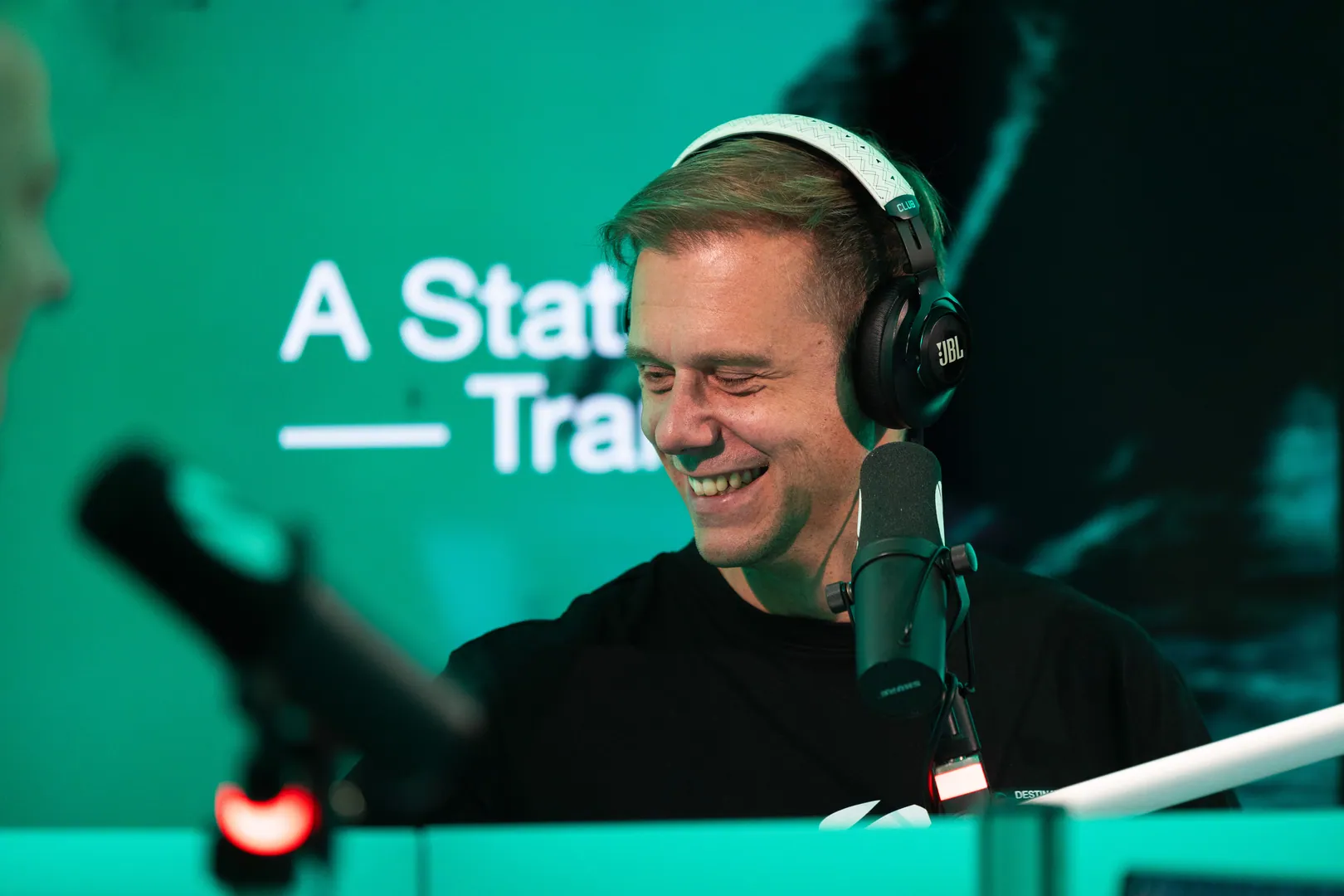
A State of Trance has grown from a radio show into a global ecosystem — radio, festivals, events, and a community. When you look at ASOT today, what part of it still feels the most personal to you?
The radio show. Sitting down every week, selecting music, telling stories, connecting with listeners — that still feels incredibly personal. It’s where everything started, and it’s where I still feel closest to the community. And I play the show in front of a real audience every single week, which is one of my favourite things to do.
After more than two decades at the top, what still excites you about stepping into the DJ booth or studio — and what no longer feels essential to prove?
What excites me is connection — that moment when a track lands and you feel the room respond instantly. That never gets old. What I no longer feel the need to prove is my relevance or my range. I’ve learned to trust my instincts and focus on what feels authentic rather than what’s expected.
You’re about to return to Singapore to play MARQUEE. What are you most looking forward to about playing there again?
MARQUEE is all about energy. The sound system, the production, the crowd — everything is built for impact. Singaporean audiences bring a real intensity and openness, and in a venue like that, you can take musical risks and feel them pay off immediately. It’s always a special experience, and I’m excited to return.
View this post on Instagram
Purchase tickets for Armin van Buuren's return to MARQUEE Singapore here.
Like what you read? Show our writer some love!
1