
When it comes to Cheerful Music, many may not immediately recognize the name. However, mention the viral hit 'Yi Xiao Jiang Hu', and nearly every short-video user can instantly hum its familiar melody. As of October, the track 'Yi Xiao Jiang Hu' (featured in Ke Mu San) has gone viral globally, amassing over 50 billion views on TikTok alone. Other breakout hits such as 'Xiao Cheng Xia Tian' and 'Xiang Si Yao' also originate from this young, innovative music label headquartered in Shenzhen.
Recently, Snow Jiang, founder and CEO of Cheerful Music, was invited to speak at Harvard Business School, where she shared her entrepreneurial journey and industry insights with an audience eager to explore digital music business models and management.
Founded in 2019 and based in Shenzhen, China, Cheerful Music focuses on discovering emerging local talents and promoting original music. Leveraging sharp market intuition, the company has produced a string of viral singles, including widely circulated tracks such as 'Yi Xiao Jiang Hu (Ke Mu San)', 'Ta Shan He', and 'Xiang Si Yao'. These songs have sparked nationwide cover challenges and collectively amassed hundreds of billions of streams across short-video platforms.
With the explosive growth of mobile internet, social media, and short-video platforms, Cheerful Music has rapidly risen to become one of China's leading music copyright enterprises within just a few years. In 2023, the company established a London office, marking a critical step in its international expansion strategy. This move not only facilitates direct collaboration with global artists but also lays a solid foundation for entry into European and North American markets.
However, international growth presents challenges such as adapting business models and bridging cultural differences. Snow explained the company’s approach: “Melody transcends borders, while lyrics tend to be more limiting.” This philosophy underpins Cheerful Music’s collaboration between its Chinese and English teams—each retaining local market expertise while jointly creating bilingual songs and international music camps designed to produce globally resonant hits. In October, Cheerful Music was officially selected as a Harvard Business School case study for its unique business model and growth trajectory.

As the featured live guest, Snow Jiang participated in the session to share her experience and insights with two cohorts totaling 137 business leaders from over 80 countries. Snow engaged with Professor Shunyuan Zhang and students to discuss the opportunities and challenges facing the digital music industry. She began by updating the audience on Cheerful Music’s latest developments: “After reading our case, many of you probably want to know what’s currently happening at Cheerful Music. I’m glad to take this opportunity to share our progress.”
AI music tools emerged as a key topic during the session. Since the debut of MuseNet in 2019, AI-driven music tools like Jukebox, MusicLM, MusicGen, Suno AI, and Udio have rapidly evolved. Nevertheless, Snow emphasized that Cheerful Music does not fully rely on AI tools at this stage for three main reasons: First, AI-generated music remains less mature than works produced by professional musicians. Second, streaming platforms currently do not pay royalties for AI-created tracks, limiting revenue potential. Third, unresolved copyright issues pose significant legal risks. “This reality requires us to proceed with particular caution,” she emphasized, adding that Cheerful Music will remain attentive to developments in AI music and adjust its strategy accordingly.
Beyond technological trends, Snow outlined several key business expansions over the past year. One focus is the instrumental music market: “Our research shows that instrumental genres, particularly sleep music, are rapidly gaining popularity, reflecting the high stress levels people face today.” Accordingly, Cheerful Music is expanding its instrumental library with an emphasis on sleep music, alongside diverse genres including lo-fi, jazz, and dance.
Over time, the label’s catalog has become increasingly comprehensive and varied, covering styles from gufeng and pop to electronic dance, lo-fi, minority-language music, and classical. This diversity provides a significant advantage in the music licensing market, contributing to Cheerful Music becoming one of the first Chinese labels invited to join Apple Music’s official Curator program. “In May, our London office finalized a three-year global licensing agreement with Mood Media, a top-three global provider of in-store background music. This partnership ensures our music will be widely distributed across retail outlets worldwide, reaching a broader audience,” said Snow.

To expand its influence, Cheerful Music has begun showcasing at international music festivals. “Last month, we were invited to participate in The Great Escape (TGE), one of the UK’s three major music festivals. This October, we will become the first Chinese music label to host an official venue at the Amsterdam Dance Event (ADE), Europe’s largest electronic music festival. These opportunities allow us to engage directly with musicians and label executives from around the world,” she shared.
Regarding international collaboration, Snow emphasized the importance of cultural exchange between East and West. The company plans to host writing camps in China and the Netherlands within the year. “We aim to invite Western songwriters to China to experience Chinese music and culture firsthand, while also bringing Chinese musicians to the Netherlands to immerse themselves in Western musical culture. This initiative will help make our music creation more international and fusion-oriented.”
During the session, Snow also showcased bilingual music videos created with international artists. She shared recent hits, including 'Xiang Si Yao', which dominated over 600 global music charts earlier this year. On TikTok, more than 10 million users have incorporated the track into their short videos, with over 10 million participating in national-style dance challenges featuring the song’s soundtrack. Total TikTok views have exceeded 5 billion.
Another standout track, 'Yi Xiao Jiang Hu (Ke Mu San)', gained renewed popularity in Japan following a “100-day Naruto dance challenge,” swiftly rising to number two on Spotify’s Japan Top 50 chart.
The subsequent Q&A session sparked lively engagement. One attendee asked why Cheerful Music had not chosen to open offices in Southeast Asian markets such as Vietnam or Malaysia. Snow explained that while these markets share cultural similarities with China, they are classified as minor language markets with narrower reach. “Music limited to such regions would have a smaller audience scale, which is why we initially chose to focus on English and global markets as our strategic entry point,” she said.
Another attendee from the Middle East asked about Snow’s personal sacrifices. He referenced her decision to sell her only house to ease the company’s financial pressure. Snow responded candidly, “I’ve always had strong faith in Cheerful Music’s future and was prepared to accept both success and failure. Even under immense pressure, I never wavered in my commitment.” When asked whether she would make the same choice again, she replied, “Absolutely.”
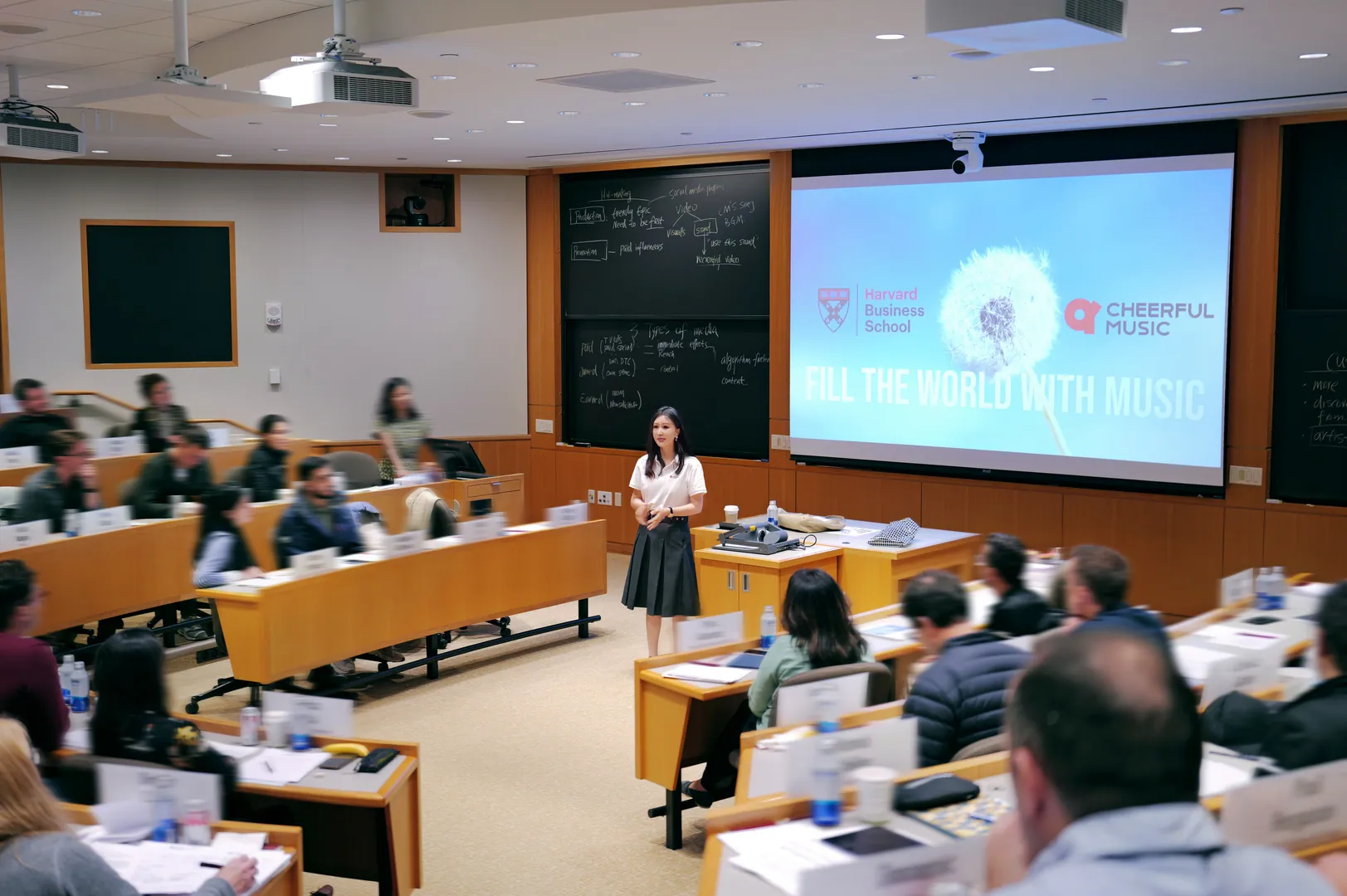
When asked about the challenges of managing a UK-based team, Snow cited language barriers, cultural differences, and varying communication styles as significant obstacles—all of which require thoughtful navigation as part of the company’s internationalization process.
Following the session, discussions continued with enthusiasm. A French student was inspired to write an article about Snow’s entrepreneurial story. An American attendee said he planned to share Snow’s story with his two daughters as an example of female leadership and resilience. Another student praised the dandelion design in Cheerful Music’s logo, calling it a perfect representation of the brand’s mission to “Fill The World With Music.”
Looking ahead, Snow articulated a clear strategic vision: to sustain Cheerful Music’s core strengths in original content and viral hits, while investing in the development of musical talent across both Eastern and Western markets. She emphasized the importance of adopting emerging technologies such as AI-generated music in a flexible, considered way—balancing innovation with long-term business sustainability.
From a viral hit maker to a featured Harvard Business School case study, Cheerful Music exemplifies how a new generation of Chinese music label is navigating the digital music era and globalizing through the lens of internet-native entrepreneurship.
Presented by: Cheerful Music
Let’s Spotlight+ your news together! Simpy submit a request through our form to get started.
Like what you read? Show our writer some love!
-