Before getting into the controversy, Massive Attack’s Singapore concert on 29 July was, in this writer’s opinion, far and away the best show the country has seen this year. It was transcendent, thought-provoking and deeply moving — the kind of performance that reminded you what live music can achieve when sound, visuals, politics, and emotion come together with absolute purpose.
The British trip-hop pioneers did not simply play a collection of songs. They built an overwhelming audiovisual experience that felt urgent, unsettling, and profoundly human. And yet, one of the biggest conversations to emerge from the night has not been about the concert itself. Instead, it has been about a flag.
Near the end of the performance at The Star Theatre, Massive Attack members Robert “3D” Del Naja and Grant “Daddy G” Marshall held up a Palestinian flag as the audience cheered. Del Naja then said “Free Palestine”, after which members of the crowd independently took up the chant.
In the days after the show, Singapore Police confirmed that reports had been lodged and investigations were ongoing. The Infocomm Media Development Authority also said it was investigating a possible breach of the concert’s licence conditions.
Concert promoter Lushington Entertainments said it was aware of the reports and would “fully cooperate with the relevant authorities as required”.
The band also told the audience that it had removed a song from its setlist because of “local laws”, although it did not elaborate further. At the time of writing, the authorities have not confirmed which song was omitted or why.
View this post on Instagram
For readers unfamiliar with the controversy, Singapore does not allow the public display of foreign national emblems without a permit or exemption. Those convicted of doing so may face a fine of up to S$500, imprisonment of up to six months, or both.
That explains why the authorities have the power to investigate the incident. It does not make the situation any less ridiculous. There was no reported violence. No threat to the audience. No indication that the concert became unsafe. Two musicians held up a flag, members of the crowd cheered, and the show came to an end.
Yet somewhere between the stage lights going down and everyone heading home, the moment became a police and regulatory matter. Massive Attack raised a Palestinian flag. Singapore raised an investigation. Only here could an expression of solidarity generate this much paperwork.
To be clear, visiting artists are not exempt from local laws. Musicians, promoters, and venues are expected to comply with the conditions attached to their performances, whether or not they personally agree with them. But legality and proportionality are not the same thing. A regulation may provide grounds for an investigation without making that investigation sensible, necessary, or remotely proportionate to what actually happened. Context should matter.
Massive Attack were not encouraging violence. They were not promoting an armed organisation. They were not placing the audience in danger or transforming the venue into an unsafe environment. They displayed a flag associated with the Palestinian people and voiced their support for Palestinian freedom. A Palestinian flag is not the flag of Hamas. Support for Palestinian civilians, dignity, freedom, or statehood should not automatically be treated as a threat to public order.
Yet the official response risks blurring that distinction. It turns a brief gesture of solidarity into something suspicious enough to warrant police reports, licensing scrutiny, and the possibility of criminal penalties. And for what?
The audience saw the flag. Some concertgoers cheered. Others may have disagreed. The country did not descend into chaos. The performance ended. Singapore remained standing. The political nature of the gesture should not have surprised anyone either.
Massive Attack have spent decades incorporating questions of war, state power, surveillance, inequality, and human rights into their work. Their politics are not an inconvenient addition to their music. They are woven into the group’s identity and creative output.
In 2025, the band also helped establish a collective supporting musicians who had spoken out about Israel’s military actions in Gaza, alleging that artists faced intimidation and pressure within the music industry for doing so. Political expression is not an unexpected interruption at a Massive Attack concert. It is part of the concert.
Fans do not attend their shows expecting the uncomfortable parts of the world to be neatly edited out. They go knowing the group has something to say and that the performance may ask more of them than passive enjoyment. That does not mean every audience member must agree with the band. It means artists should be able to articulate a position without every uncomfortable gesture being escalated into a potential public-order issue.
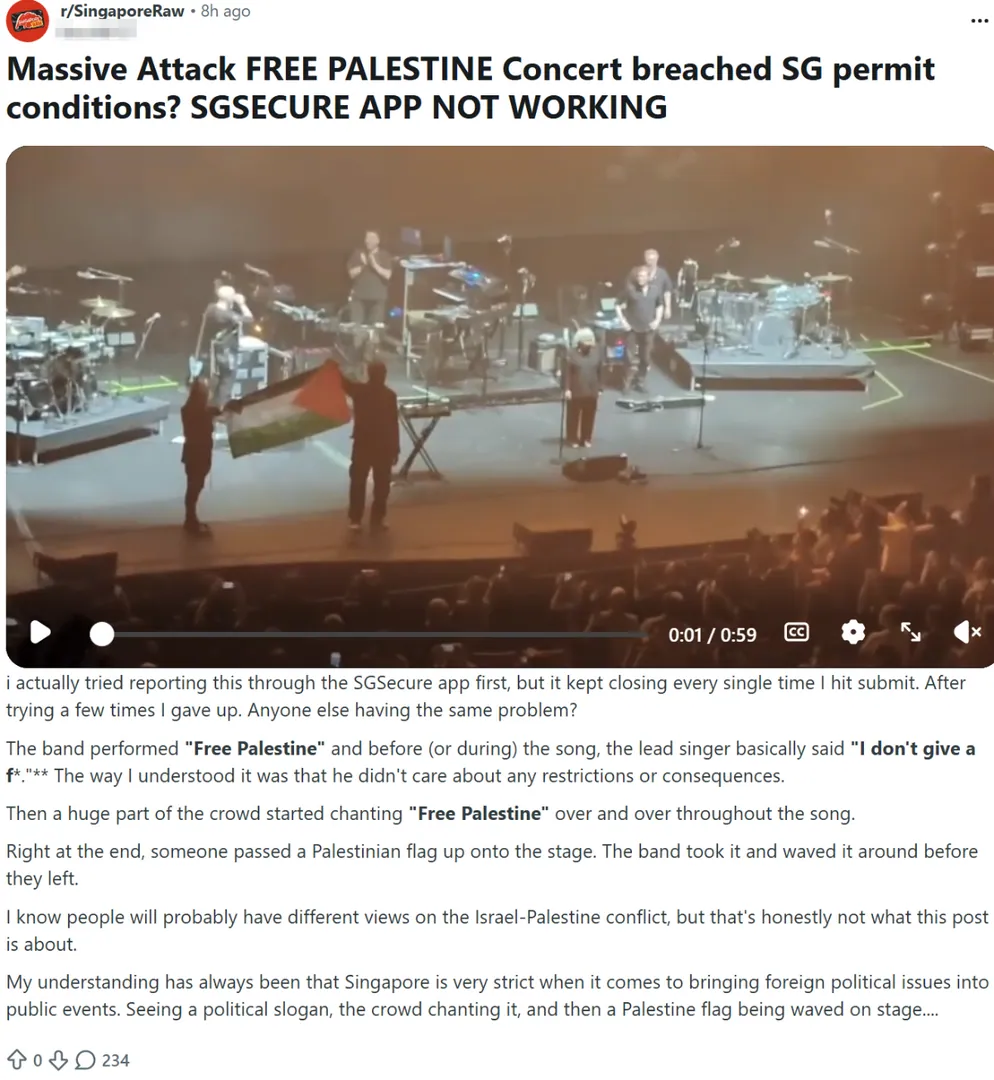
Singaporeans often joke that complaining is a national pastime. Something happens. Someone takes offence. A report gets filed. Suddenly, a moment that might otherwise have passed becomes an official matter requiring statements, investigations, and administrative attention.
That instinct can be useful when genuine harm has occurred. But not every source of discomfort is dangerous. Not every disagreement demands intervention. And not everything that happens on a concert stage needs to become a police report. The urge to complain about anything remotely contentious can produce a society that is orderly but increasingly unable to distinguish between actual harm and simple unease. A flag may make some people uncomfortable. Discomfort is not disorder.
There is also a wider concern for Singapore’s live music scene. The country has worked hard to establish itself as a major touring destination in Asia. International artists, promoters, and fans increasingly view Singapore as a reliable stop for arena concerts, theatre performances, and large-scale cultural events.
But a thriving concert ecosystem cannot be built solely on efficient venues, clean facilities, and orderly crowds. It also requires space for artists to be artists. Music has never existed outside politics. From protest songs and benefit concerts to stage speeches and visual statements, musicians have always used live performance to respond to the world around them.
Audiences are capable of encountering those ideas. They can applaud, disagree, remain silent, walk away, or argue about them after the lights come on. That exchange is part of what gives live music its meaning. It is not disorder. It is culture.
That was especially evident during Massive Attack’s performance. The show was moving precisely because it refused to separate art from the world that produced it. Its visuals, music, and messages worked together to confront the audience with questions of violence, power, and human suffering. Removing that political dimension would not have made the concert more neutral. It would have made it less honest.
The authorities will determine whether Massive Attack breached the conditions attached to their performance licence. But the public is equally entitled to ask whether an alleged breach deserved this degree of scrutiny in the first place. A Palestinian flag appeared at a concert. It did not place the audience in danger. It did not threaten Singapore’s stability. It did not require a national demonstration of bureaucratic efficiency.
Perhaps, instead of rushing to complain, report, and investigate, we could acknowledge the moment for what it was: a political gesture by an openly political band during one of the most remarkable concerts Singapore has hosted this year. Massive Attack raised a flag. The crowd responded. The music continued. Perhaps we should have simply allowed the moment to speak for itself.
Like what you read? Show our writer some love!
22